





Life Cycle Assessment
- Food-related emissions per meal were 787.96 g CO2e (2025).
- According to calculations by Eaternity, food-related Scope 3 emissions for 2025 amounted to 1,038.87 t CO2e. Compared to 2,259 t CO₂e in 2019, this represents a reduction of 54%. The 2019 figure comes from Andreas Hintz’s master’s thesis (“Greenhouse Gas Emissions of the Campus Catering Services of Studierendenwerk Ulm – Analysis of the Reduction Potential of Scope 3 Emissions through Nudging”).
- As early as 2020, Dr. Johannison and students from Ulm University examined the life cycle assessment of selected dishes as part of a seminar. Based on this, recipes were revised.
Vegetarian and Vegan
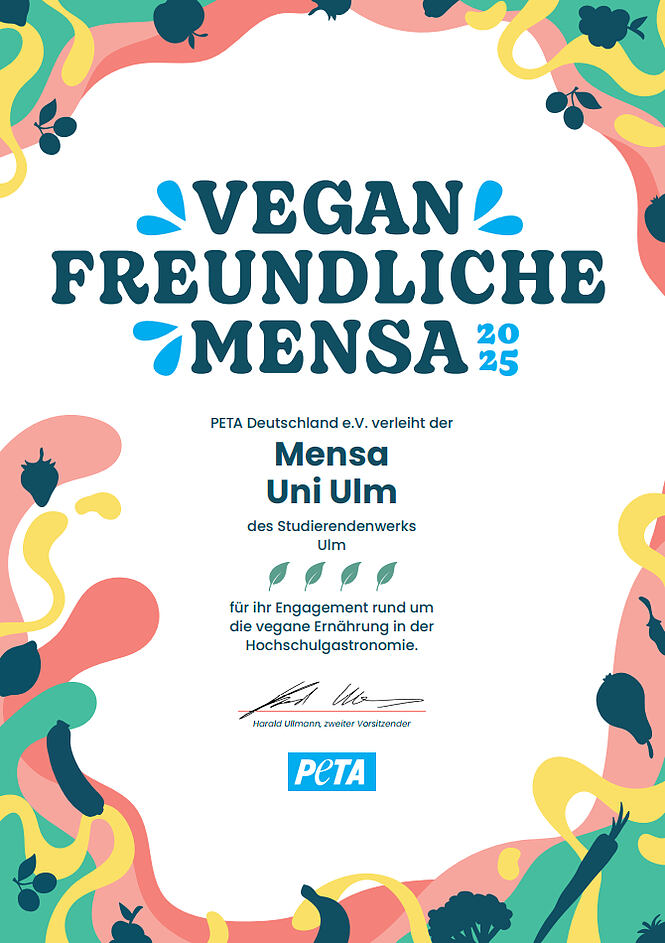
- In 2026, the animal rights organization PETA awarded all canteens operated by Studierendenwerk Ulm Gold status as vegan-friendly canteens.
- 69.38% of the dishes sold were vegetarian or vegan (2025).
- Plant-based alternatives to milk (and dairy products) accounted for 14,663.88 liters, representing 15.76% of the total milk requirement (2025).
- Menu offering with a high proportion of vegetarian and vegan dishes (approximately 70% since the winter semester 2023/2024).
- The cafeterias offer vegan muffins, Bircher muesli, and vegan salads. Further vegan snack options, particularly baked goods with homemade spreads, are actively being developed.
Animal Welfare
Animal Welfare
When selecting ingredients for prepared meals, particular importance is placed on their origin and quality. Where available and taking costs into consideration, fresh meat products from animal-friendly farming systems and regional butchers within a maximum radius of 100 km are sourced.
Beef and pork are sourced exclusively from Bavaria and Baden-Württemberg. Fresh poultry meat is sourced from Germany or neighboring Austria. This regional restriction on the keeping and rearing of animals, including access to an outdoor climate, corresponds to at least Farming Method 3, as known from the retail sector.
Current suppliers:
- Metzgerei Adolf Baur GmbH, 87671 Ronsberg im Allgäu
- Metzgerei Buchmann GmbH, 88287 Grünkraut in the Ravensburg area
- Omega Sorg GmbH, 73457 Essingen in the Ostalb region
- Kröswang GmbH, 4710 Grieskirchen
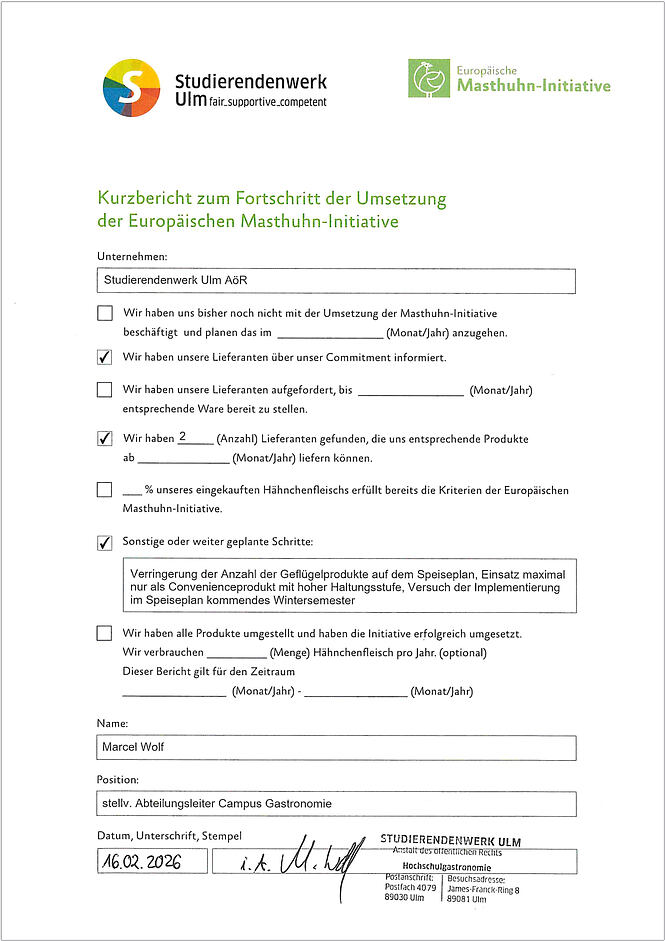
Studierendenwerk Ulm is working to implement the requirements of the European Chicken Commitment for the chicken meat it procures. Progress is reported on annually; compliance with the standards is verified through independent audits. Until meat that meets all the criteria is available, comparable products are used and their share of the range is gradually increased.
75% of the fish purchased in 2025 was MSC-certified.
PETA
The animal rights organization PETA awarded all canteens operated by Studierendenwerk Ulm Gold status as vegan-friendly canteens (2026).
Conserve resources, save energy
- Since 2026, real-time AI forecasts provided by the company better bites have been used in facilities at Ulm University and Aalen University of Applied Sciences. The aim is to achieve more precise procurement, reduce food waste and achieve measurable savings.
- The conveyor dishwasher and the wet waste disposal system in the canteen at Ulm University were renewed in summer 2026. The aim is to improve workplace ergonomics, save energy and reduce the use of cleaning agents.
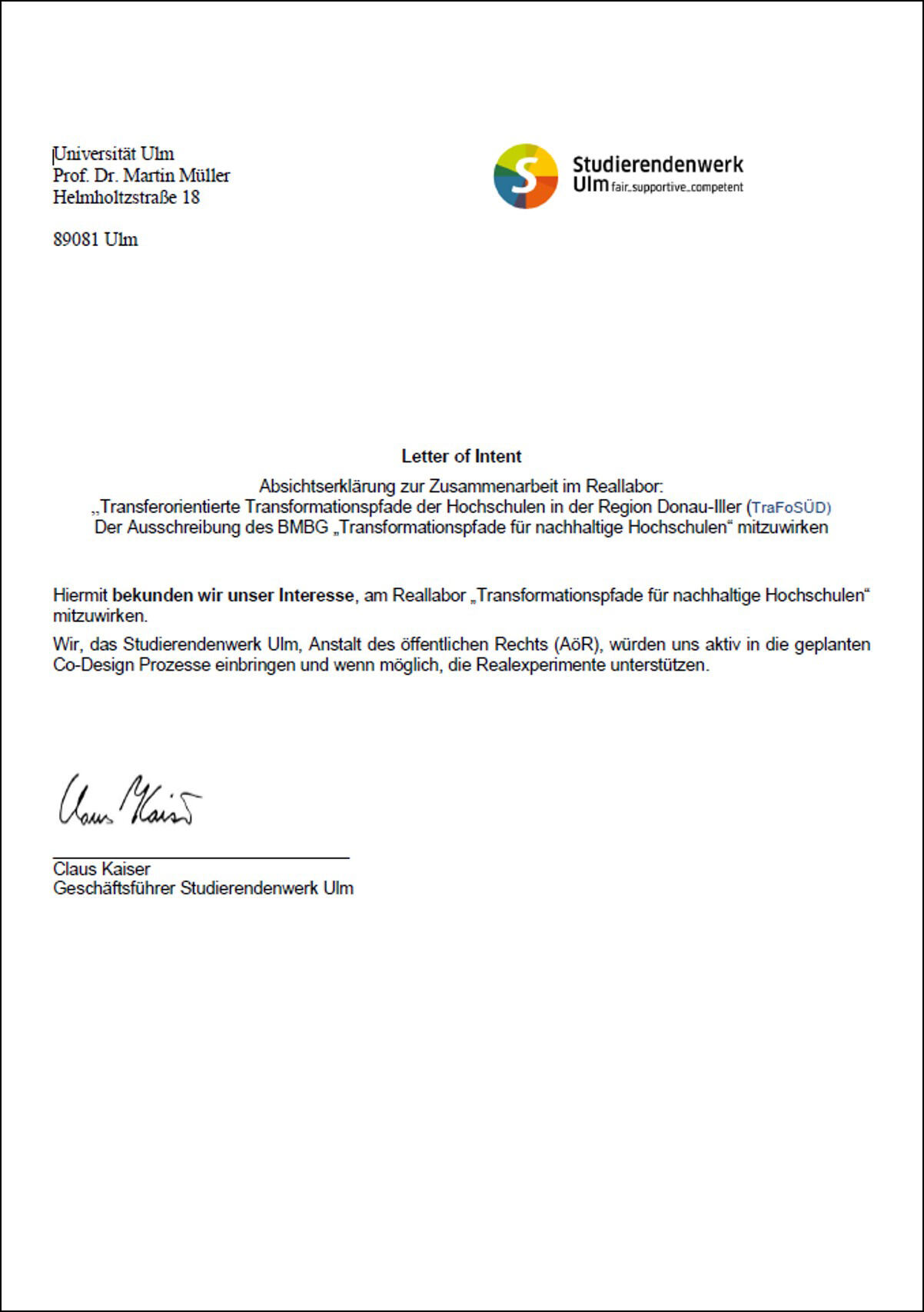
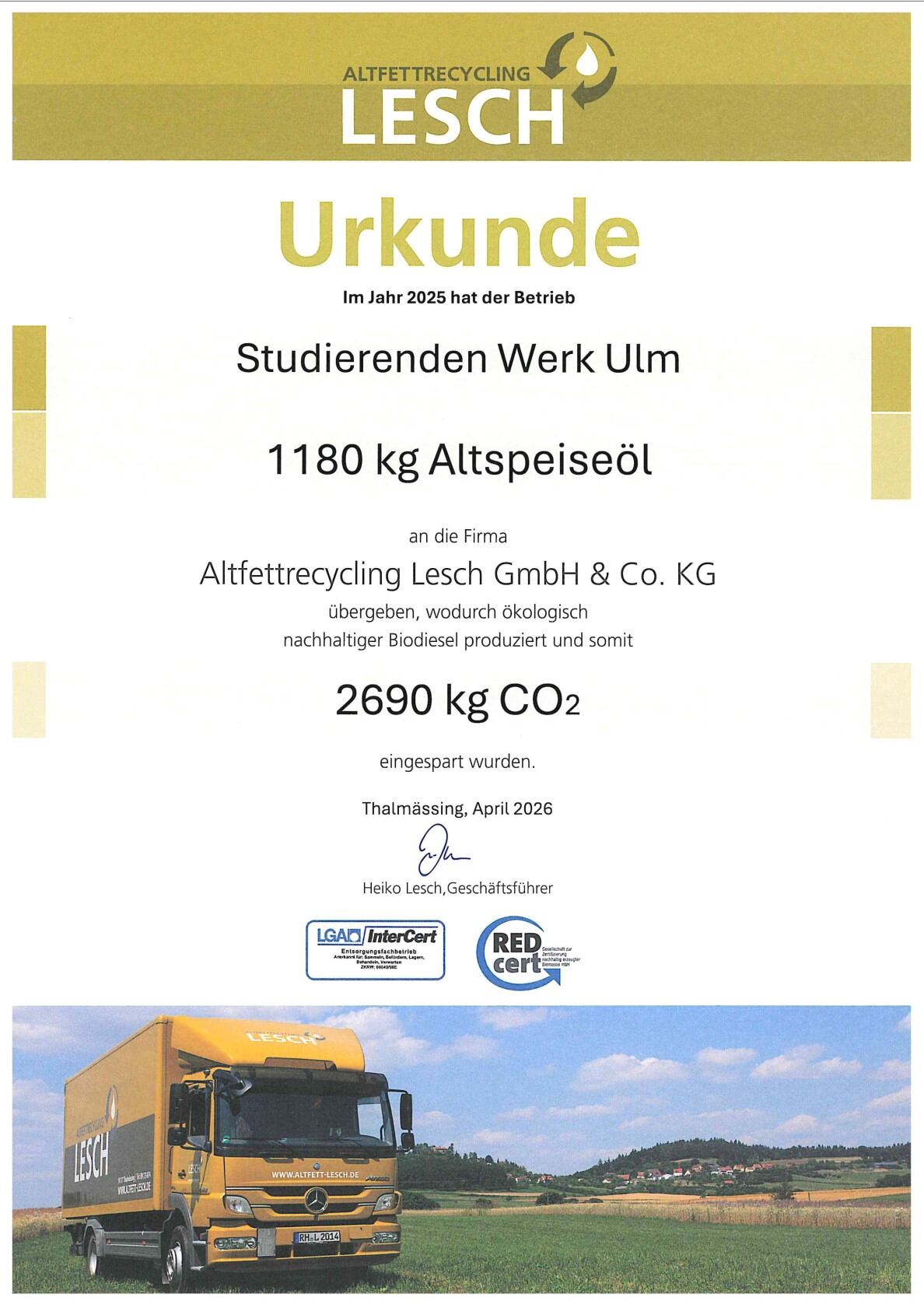
- Since 2019, Campusgastronomie has been handing over used cooking oil to Altfettrecycling Lesch GmbH & Co. KG for the production of biodiesel. According to the available data, recycling 1.88 t of used cooking oil saved 4.29 t of CO₂ in 2025.
- The cooking operation of the Mensaria at Schwäbisch Gmünd University of Education was converted from natural gas to electricity during the 2024 Christmas break. Since then, production in the Studierendenwerk's catering facilities has been powered by green electricity from renewable energy sources.
- With the completion of the renovation of the canteen at Ulm University for the winter semester 2024, heat recovery, recycled concrete, energy optimization systems, motion sensors and a daylight façade with shading were implemented, among other measures. The roof was also equipped with approximately 450 m² of sedum greenery.
- Products approaching their best-before date are offered at half price in the cafeterias.
- “Good from Yesterday” products in cafeterias, such as filled rolls, snacks, muffins, Danish pastries, etc., and other products are offered at half price.
- At food outlets that do not prepare food themselves, an ordering system is used for the Meat & Fish food line in order to produce according to demand and reduce food waste.
- At Ulm University, locations are provided for foodsharing’s Fairteiler cabinets; responsibility lies with students.
- In the product categories bakery products, fresh whole fruit, sliced cold cuts and fresh meat, regional food from within a maximum radius of 250 km is used.
Fair Trade
- Around 98% of the coffee is sourced from fair trade and is organically certified; in 2025, this corresponded to sales of just under 5 t.
- As a cooperation partner, Studierendenwerk supports the Fairtrade University activities of Ulm University of Applied Sciences (since 2019, most recently recertified in December 2025) and Heidenheim Cooperative State University (since 2025). Aalen University of Applied Sciences held the status from 2016 to 2022.
- Studierendenwerk supports the initiative of the Sustainability Department of the student representative body at Ulm University on its way to achieving Fairtrade status (2025–2026, see Projects).
- Fair trade products such as coffee, sugar sticks, beverages, biscuits, bars, dried mangoes, ice cream, etc. are offered.
- Ulm University of Applied Sciences was nominated in the “Rising Star” category at the Fairtrade Awards in 2024. On this occasion, the Sustainability Officer of Studierendenwerk Ulm, together with Ulm University of Applied Sciences, presented their collaboration as a best practice at an online meet-up of Fairtrade Universities. Information on the 2024 Fairtrade Awards.
- As a company, Studierendenwerk contributes to Ulm being a Fairtrade City.
- Annual Fairtrade campaign with Fairtrade lunches in all canteens and cafeterias with food service, complemented by an information stand on Fairtrade and sustainability (2022–2024, see Projects).
Sustainable coffee experience
- Approximately 98% of the coffee is sourced from fair trade and is organically certified; this corresponded to sales of just under 5 t in 2025.
- Reusable cups can be used at all coffee machines.
- Coffee cups can be borrowed against a deposit in the cafeterias and returned after use.
- Disposable coffee cups are FSC-certified.
- As an alternative to portion packs, milk dispensers have been purchased in some locations.
Reusable instead of disposable, packaging and materials
REUSABLE INSTEAD OF DISPOSABLE, PACKAGING AND MATERIALS
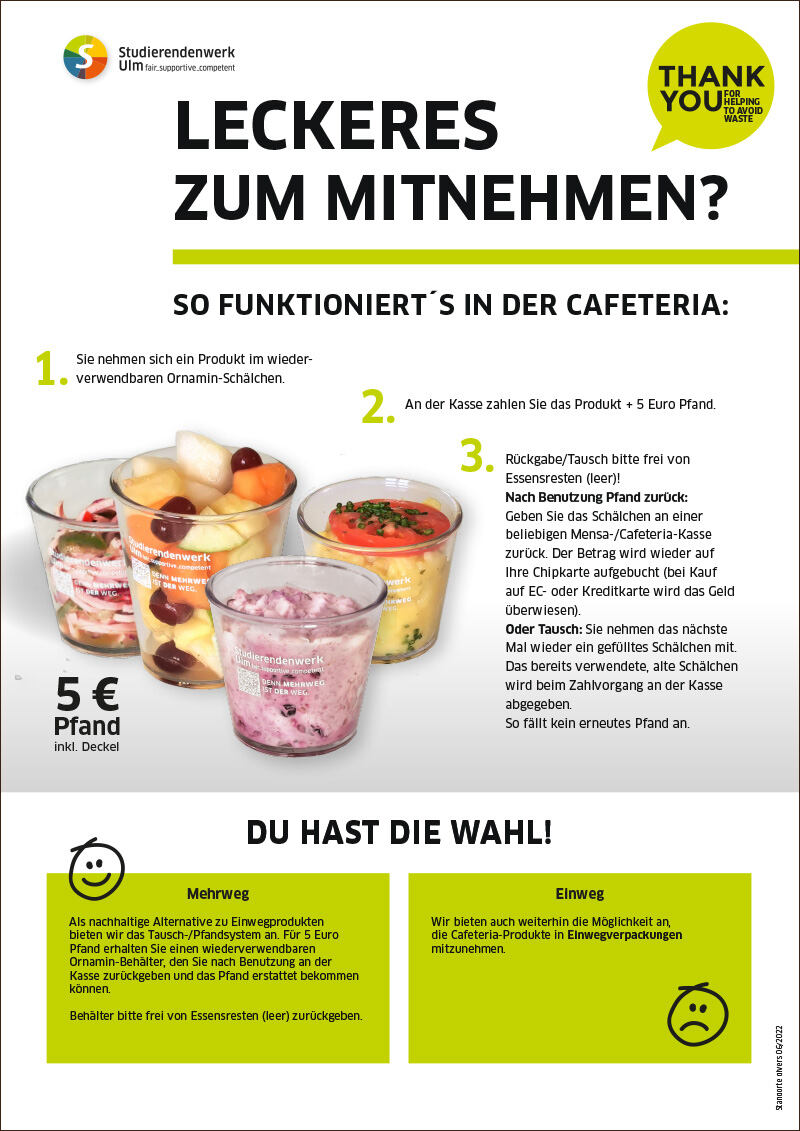
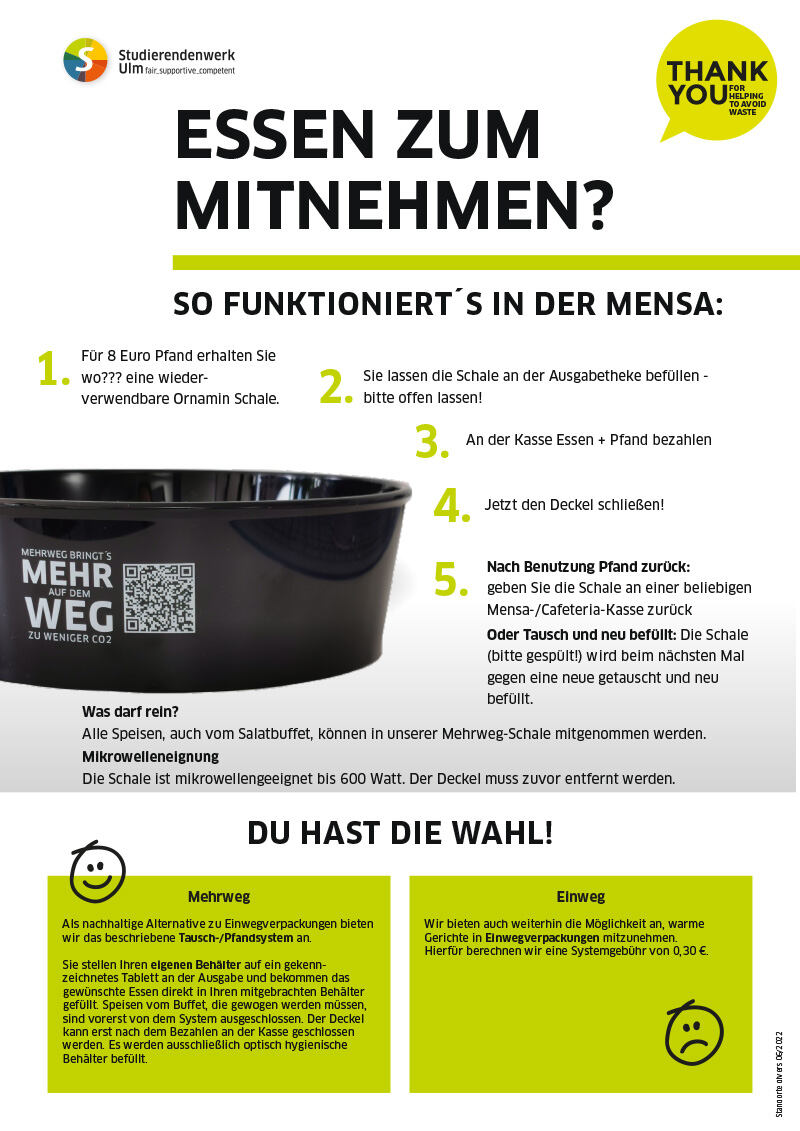
- In 2025, a total of 36,543 reusable tableware items were issued, including coffee cups, muesli cups and food containers. 36,749 items were returned. The calculated return rate of 100.56% is explained by additional returns of stock from previous years.
- At the coffee stations of DHBW Heidenheim, exclusively reusable deposit cups have been used since January 15, 2025, at the initiative of the university.
- Since the summer semester 2022, muesli cups and food containers can be borrowed against a deposit at all cafeterias and canteens and, upon return, the deposit can either be refunded or the used item can be exchanged for clean tableware.
- Plastic packaging, for example for muesli or salad, has been changed from PTE to PLA made from renewable raw materials.
- Disposable packaging continues to be available for a system fee. Lids for disposable coffee cups are only provided upon explicit request.
- In the snack vans, aluminum foil has been replaced with recyclable containers. Other disposable packaging and napkins have been switched to products made from recycled materials.
- Plastic drinking straws are not used.
- Milk dispensers have been purchased as an alternative to portion packs.
- Salt and pepper shakers are being reintroduced in the canteen at THU Prittwitzstraße and at the dining areas at the Oberer Eselsberg location.
- Waste separation is supported by clear signage.

Support and collaboration
- Support for THU in obtaining its Fairtrade University designation since 2019, as well as in renewing the designation (most recently in 2025).
- Supporting DHBW Heidenheim in its bid to be designated a Fairtrade University (2025).
- Annual PAN campaign featuring healthy meals and dishes selected to help prevent certain diseases, served in university dining halls and cafeterias (2023–2025; see Projects).
- Participation in the 2022 Sustainability Days at Biberach University of Applied Sciences from October 17–21, 2022.
- Provision of locations for foodsharing's “Fairteiler” cabinets at the University of Ulm (under the students' responsibility).
- Contribution to the City of Ulm's designation as a Fairtrade City.
Conscious menu planning
- During the winter semester 2025, freshly made pasta produced in-house was offered once a week at a promotional counter in the canteen at Ulm University.
- Since the summer semester 2024, nutritional values have been provided to support conscious eating habits.
- Since 2024, the SouthSide cafeteria at Ulm University has had a vending machine offering exclusively sustainable products.